
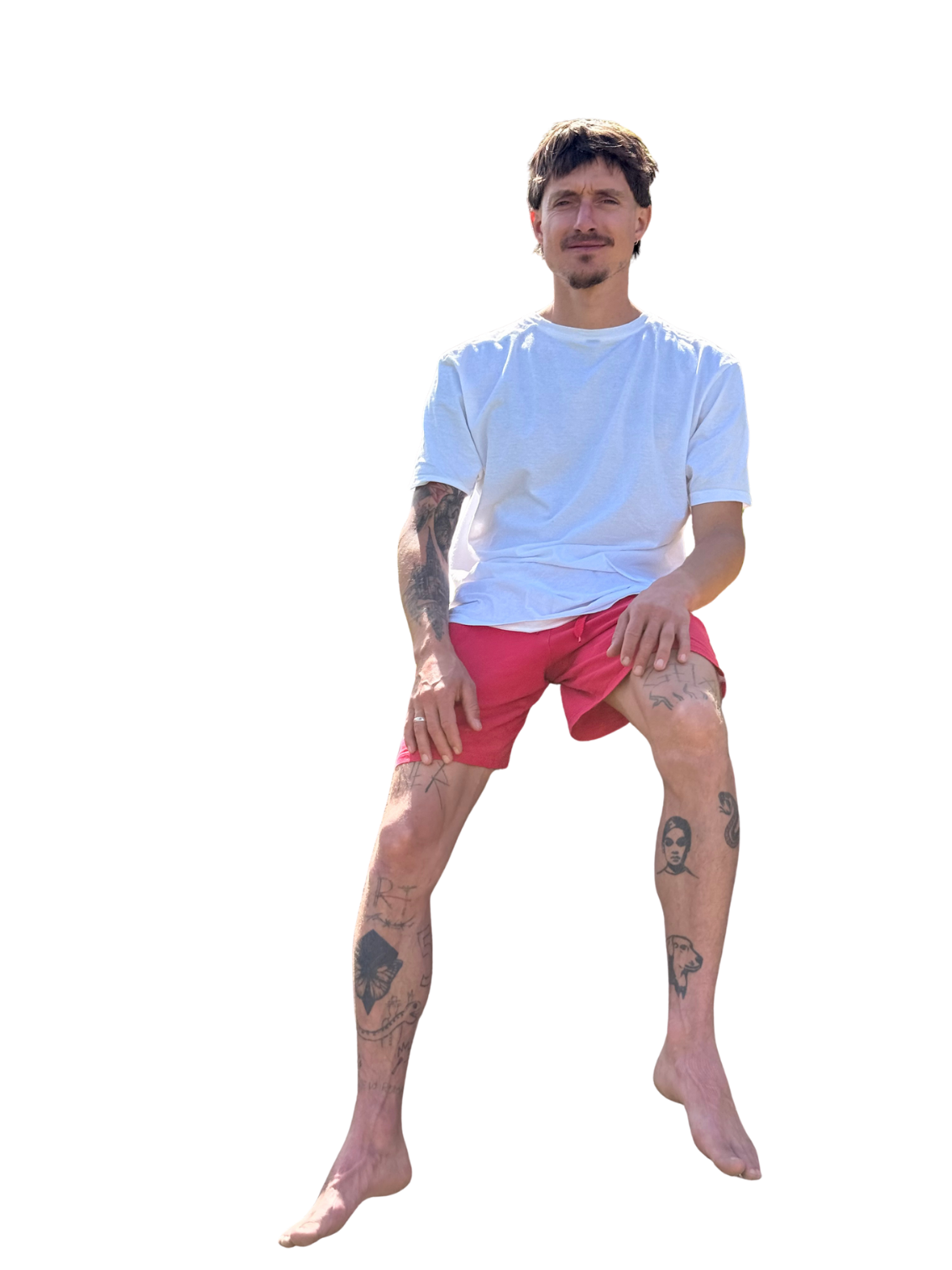
Patrick Ridlmaier is an artist based in Vienna who found his way back to his personal art practice by a roundabout route. As a hypersensitive person, he felt a deep joy from an early age in creating objects, whether with a scroll saw or by painting. The world around him would disappear, and through the process he found a sense of clarity and personal understanding of the world outside.
Without access to an artistic path growing up in rural Austria, he began an apprenticeship as a hairdresser at the age of 15, seeing it as a way to express himself physically and creatively, and finding considerable success in it. His professional path took him from Upper Austria to London and eventually to Vienna, where he opened his own salon. But it was precisely in running that business, with a team around him, that he found his way back to the world of art.
A sense of dissatisfaction and emptiness led him to question the path he had chosen. After a period of reflection spanning several years, it came back to him. He remembered the joy, the curiosity, and the deep sense of meaning he had once felt during creative processes. The urge to create grew and grew, until a few years ago Patrick decided to confront and let go of every existential fear and doubt, and to dedicate himself to art wholeheartedly and by every means available. The artistic identity PAZ returned to the world.Reconnecting with his own creativity became, once again, a way to make the world, his world, feel clearer and more joyful.
Although it was never his initial intention to exhibit his work, others quickly took notice of the expressive power of his paintings and sculptures. Through a series of coincidences, exhibitions followed: one in Vienna in winter 2025 and one in Paris in spring 2026.PAZ is well aware that he cannot draw on the technical repertoire available to students of an art academy. This is precisely why authenticity matters so much to him. Intuitive expressive power as his measure of success. Only when others, looking at one of his works, recognise something familiar, and suddenly feel a compelling vitality stir deep within themselves, is a work, a space, a situation a success for PAZ.
Art as an immediate tool, placing the viewer in a world that feels both foreign and familiar. PAZ's paintings often depict structures and situations that echo the abstract composition of our own dream worlds. Direct colours, distorted spaces, combined with themes that invite reflection and reverie. His sculptures equally reflect the artist's interest in the fluid nature of the present, giving it a more tangible, physical form.For him, the goal of his art is to capture something specific and intimate beyond time and space through various snapshots, and to change something for the viewer in the act of showing it. Because everything is transient. Every artwork included.Transience as the central theme of his work. Whether painting or sculpture.
The personal, human experience of themes such as anger, fear, but also hope and the projection of various fantasies are of particular interest to PAZ. He sees in this above all the opportunity, as a male-identifying, hypersensitive person, to invite others into a discourse around emotions and states of mind that the masculine world rarely confronts consciously. His aim is to make limitations visible and tangible, to enable individual self-reflection through the act of looking, and to invite a broader societal openness.Universal as well as individually experienced human emotions, and the resulting ways of living, thinking, and relating to the world, serve as his personal inspiration.
PAZ approaches his projects intuitively, unafraid to create harder, rawer forms and combine them with precise detail. His use of colour follows the same logic: applied raw and direct to the canvas on one hand, broken up with unexpected subtleties on the other. For sculptures, tree trunks are often observed in their natural form for hours, until the impulse arises to give them a particular expression. From the chainsaw to the round file used to work the smallest angles, a process begins that can take days or even weeks.His love of wood also leads PAZ to build his own picture frames. A distinctive quality that borders his selected paintings in an unmistakable way.Even when it is difficult, it matters to the artist to always wait for that inner impulse. The moment when a genuine obsession suddenly appears and drives him to reach for the brush or the saw. Only then does he experience the satisfaction of a process in which the outside world fades away and only the act of creation exists.Authenticity as the measure of his own success.
For sculptures, PAZ works primarily with wood, using exclusively recycled timber or offcuts sourced from local woodworkers or found on walks. Reusability and a conscious, environmentally considered way of working matter to him. He also believes that objects defined by a former purpose and transformed through artistic processes into abstract art or crafted functional objects carry more expressive power and vitality than new materials.His paintings are mostly made with acrylic paint on varying surfaces, from old recycled wooden boards to canvases. PAZ paints on whatever feels intuitively right for each project.
